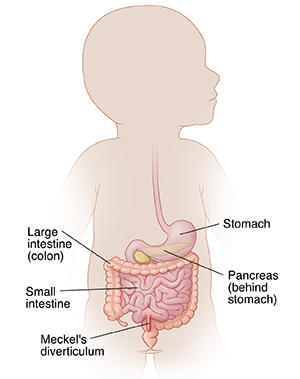
A Meckel’s diverticulum is a small pouch of tissue on the bowel (intestine). It forms before birth (congenital), when a fetus is still growing in the uterus.
Most children with this condition never have problems from it. But the pouch may bleed. It may also become infected. Or the intestine can twist around it. If any of these problems occur, the Meckel’s diverticulum must be removed.
What are the symptoms of Meckel’s diverticulum?
Many children with this condition never have symptoms.
When a child does have a problem, it’s often around age 2. The most common signs of a problem include:
-
Blood in stool.
-
Low energy and pale skin. These are caused by low levels of red blood cells (anemia) due to blood loss.
-
Signs of infection such as fever, chills, or belly pain.
-
Signs of intestinal blockage such as nausea, vomiting, and pain.
How is Meckel’s diverticulum diagnosed?
It’s common for the problem to not be found unless it causes symptoms. If your child has symptoms, they may have tests such as:
-
Blood tests. These check for signs of bleeding or infection.
-
Stool sample. This may be done to check for blood.
-
Meckel’s scan. A special dye is injected into the child’s bloodstream. This dye may make the Meckel’s tissue show up on a scan.
-
Ultrasound. This test uses sound waves to make images.
-
Arteriogram. This is a special X-ray test. Dye is injected into the arteries to look for bleeding. This may be done if bleeding is severe and the source can't be found.
-
Other tests. Imaging tests such as an X-ray or CT scan may be done to rule out other problems.
How is Meckel’s diverticulum treated?
If your child has no symptoms, treatment may not be needed. But if your child has symptoms, surgery may be needed to remove the pouch. This may be done by laparoscopic or open surgery. After surgery, the symptoms will usually go away. The pouch will not grow back.
Featured in
Online Medical Reviewer: Chelsey Schilling BSN RN
Online Medical Reviewer: Daphne Pierce-Smith RN MSN
Online Medical Reviewer: Lalitha Kadali
Date Last Reviewed: 06/01/2025
© 2000-2026 The StayWell Company, LLC. All rights reserved. This information is not intended as a substitute for professional medical care. Always follow your healthcare professional's instructions.