Artificial tears are the most common treatment for dry eyes. If they don't ease your symptoms, your eye doctor may advise medicine. This is to increase tear production and reduce inflammation. Or they may advise putting in plugs. In some cases, surgery may be advised. This is done to stop the draining and increase the tear film.
Artificial tears
Artificial tears (lubricating eye drops) replace your natural lubricating tears. You can buy most lubricating eye drops without a prescription. And you can use them as often as needed. These are not the same as eye drops used to ease redness or itching. Check with your eye doctor or pharmacist to be sure you buy the right drops.
Some lubricating eye drops have chemicals called preservatives. This makes them last longer inside the bottle. Your eyes may not handle these drops well. Or you may need to use them more often than you would like. If so, you may want to buy lubricating eye drops made without preservatives. Your eye doctor may also advise using a lubricating eye ointment at night.
Medicine
Your eye doctor may prescribe medicine, such as cyclosporine or lifitegrast, to treat your eye condition. It can help increase your eyes' ability to make tears.
Plugs
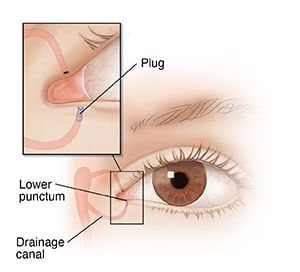
Closing the eye's tiny tear ducts (puncta) with plugs can help keep the tear film on your eye longer. The plug acts like a stopper in a sink. It allows only a small amount of tears to drain out of your eye. Your eye doctor will figure out which type of plug to use. Some may be used short-term (temporary). Others are designed to be lasting (permanent). Your eyes will be numbed with drops when the plugs are inserted. There may be mild discomfort. Generally, this isn't painful. You shouldn't feel the plugs once they're in.
Surgery
If artificial tears or plugs don't ease your dry eyes, surgery may be a choice. Your eye doctor may do minor outpatient surgery to narrow or block the openings to the drainage canals. If your dry eyes are caused by eyelid problems, your eye doctor may advise other kinds of surgery.
Online Medical Reviewer: Chris Haupert MD
Online Medical Reviewer: Raymond Kent Turley BSN MSN RN
Online Medical Reviewer: Rita Sather RN
Date Last Reviewed: 09/01/2025
© 2000-2026 The StayWell Company, LLC. All rights reserved. This information is not intended as a substitute for professional medical care. Always follow your healthcare professional's instructions.