Management

For Kids: Avoiding Your Asthma Triggers

Choose a preferred language

You like to stay busy and have fun. But you may be afraid asthma will slow you down. Do your best to control your asthma. Then you can do all the things you like to do!

Draw a line from each problem on the left to the best answer on the right.
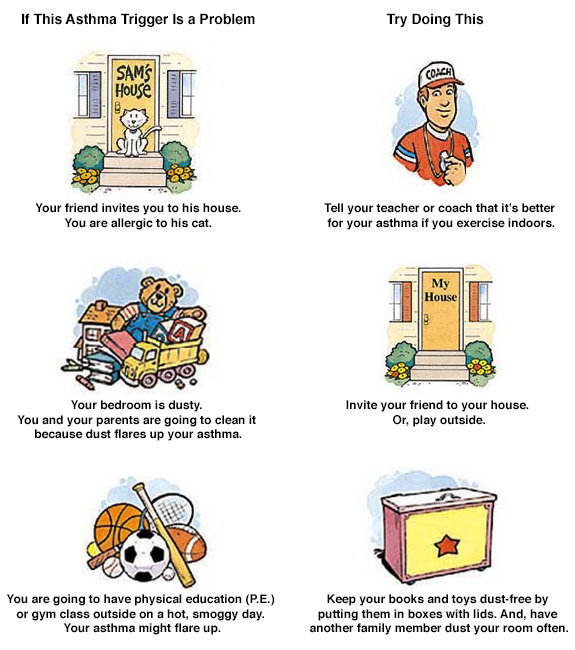
Composite image of a cat in front of a house, a coach with a whistle, a pile of toys, a front door to a house, sports equipment, and a toy chest.

Featured in

Online Medical Reviewer: Allen J Blaivas DO

Online Medical Reviewer: Amy Finke RN BSN

Online Medical Reviewer: Daphne Pierce-Smith RN MSN

Date Last Reviewed: 09/01/2024

© 2000-2026 The StayWell Company, LLC. All rights reserved. This information is not intended as a substitute for professional medical care. Always follow your healthcare professional's instructions.



FPC Locations

FPC Locations

Find a Provider

Find a Provider

Our Services

Our Services

Patient Portal

Patient Portal
Related Articles
Read article
Lung Health
Treating Asthma at School

It's important to tell your child's teachers and other school staff about your child's asthma. That way, they can help your child if symptoms get worse, or if your child has an asthma attack at school.

Read article
Emergency and Urgent Care
Understanding Skull Fracture (Child)

A skull fracture is a type of head injury. The most common causes in children include falls, sports, and motor vehicle accidents.

Read article
Emergency and Urgent Care
Broken Collarbone (Child)

Your child has a broken collarbone (fractured clavicle). The collarbone connects the breastbone to the shoulder. This injury may cause pain, swelling, bruising, and a bump (deformity) around the break. A more serious collarbone break may harm nerves and blood vessels in the area, as well as the lungs.

Read article
Digestive Health
Lab Tests to Diagnose Digestive Diseases in Children

Read on for details about common lab tests used to diagnose problems with the digestive system in children.