Many treatments can help reduce pain and swelling in your knee. Your healthcare provider may suggest one or more of the following treatments:
-
Icing your knee. This helps reduce swelling. You may be asked to ice your knee once a day or more. Apply ice for about 15 to 20 minutes at a time, with at least 40 minutes between sessions. To make an ice pack, put ice cubes in a plastic bag that seals at the top. Wrap the bag in a clean, thin towel or cloth. Never put ice or an ice pack directly on your skin.
-
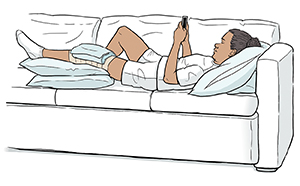
Keeping your leg raised up higher than your heart. This helps excess fluid flow out of your knee joint to reduce swelling.
-
Compression. This means wrapping an elastic bandage or neoprene sleeve snugly around your knees. It keeps fluid from collecting in and around your knee joint.
-
Electrical stimulation. This is done by a physical therapist or athletic trainer. It can help reduce excess fluid in your knee joint.
-
Anti-inflammatory medicines. These may be prescribed by your healthcare provider. You may take pills or get shots (injections) in your knee.
-
Isometric (contracting) exercises. These strengthen the muscles that support your knee joint. They also help reduce excess fluid in your knee.
Online Medical Reviewer: L Renee Watson MSN RN
Online Medical Reviewer: Raymond Turley Jr PA-C
Online Medical Reviewer: Thomas N Joseph MD
Date Last Reviewed: 10/01/2024
© 2000-2026 The StayWell Company, LLC. All rights reserved. This information is not intended as a substitute for professional medical care. Always follow your healthcare professional's instructions.