Definition

Anatomy of the Male Urinary Tract

Choose a preferred language

Your urinary tract helps to get rid of your body’s liquid waste. Here's how it works:

  • The kidneys. These constantly filter the blood to collect unneeded chemicals and water, making urine.

  • Ureters. Urine travels through the ureter tubes to the bladder.

  • The bladder. This fills with urine, holding it until you’re ready to release it. Signals from the brain tell the muscles around the opening of the bladder (sphincter) when to let urine flow out of the bladder.

  • Urethra. This is the tube that carries urine from the bladder out of the body.

  • Prostate gland. In men, the prostate gland wraps around the urethra near the bladder.
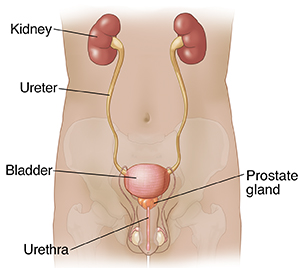
Front view of male outline showing urinary and reproductive tracts.

Online Medical Reviewer: Donna Freeborn PhD CNM FNP

Online Medical Reviewer: Marc Greenstein MD

Online Medical Reviewer: Raymond Kent Turley BSN MSN RN

Date Last Reviewed: 04/01/2024

© 2000-2026 The StayWell Company, LLC. All rights reserved. This information is not intended as a substitute for professional medical care. Always follow your healthcare professional's instructions.



FPC Locations

FPC Locations

Find a Provider

Find a Provider

Our Services

Our Services

Patient Portal

Patient Portal
Related Articles
Read article
Urology
Balanitis

Balanitis is an inflammation of the head of the penis. It can happen because of a buildup of germs (bacteria, viruses, or fungi) under the foreskin, or exposure to soaps and other chemicals. Learn how to care for yourself at home.

Read article
Urology
Urinary Incontinence (Male)

Urinary incontinence means not being able to control the release of urine from the bladder. There are many possible causes of urinary incontinence in men. Read on to learn more.

Read article
Urology
Bladder Cancer: Introduction

The bladder is a hollow organ in the lower pelvis. Learn what happens when cancer strikes this organ.

Read article
Metabolic Conditions
Abdominal Ultrasound

Abdominal ultrasound is an imaging test that uses sound waves to form pictures of your abdominal organs. It can help detect organ problems, such as gallstones, kidney stones, or liver disease.