During the development of a fetus, the testicles (male sex organs) form near the kidneys. As the unborn baby grows, the testicles move down (descend) into the scrotum. Normally, they’re in the scrotum before the baby is born. An undescended testicle means it doesn’t fully move down into the scrotum. This is also referred to as cryptorchidism.
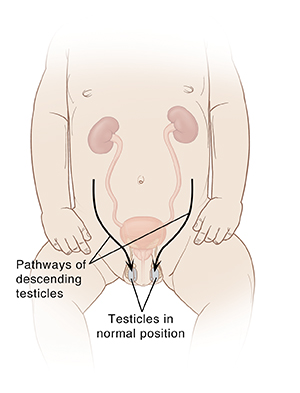
Common sites of an undescended testicle
Most often, the testicle stops descending between the groin and the scrotum. Sometimes it stops above the groin. Or it may stray off the normal pathway.
Locating an undescended testicle
Your child's healthcare provider can usually feel an undescended testicle during a physical exam. Your baby lies on their back for the exam. An older child may be asked to squat. The provider places their fingers on the child’s groin and then gently moves them toward the scrotum until the testicle is felt. If the testicle can’t be found with an exam, imaging studies, such as ultrasound, or other tests may be needed.
Watchful waiting
The healthcare provider will most likely wait for a few months to see if your child’s testicle will descend on its own. The closer the testicle is to the scrotum, the greater the chance it will come down. If the testicle doesn't descend on its own, it can still be treated. If both testicles haven't descended, or if the testicle is above the groin, the provider may advise treatment.
Treatment
Your child's healthcare provider may advise a surgical repair. This is done to locate the undescended testicle and move it to the scrotal sac. This surgery, called orchiopexy, is often done between age 6 and 9 months. It's successful in 98% of children with this condition. Early intervention may preserve future fertility and may reduce risk of cancer.
Online Medical Reviewer: Marc Greenstein MD
Online Medical Reviewer: Raymond Kent Turley BSN MSN RN
Online Medical Reviewer: Rita Sather RN
Date Last Reviewed: 02/01/2025
© 2000-2026 The StayWell Company, LLC. All rights reserved. This information is not intended as a substitute for professional medical care. Always follow your healthcare professional's instructions.